
research · Fall 2025
Thermal MEMS actuators
Silicon dioxide cantilevers with chromium heaters, designed, fabricated and measured to compare thermal actuation and resonance with analytical predictions.
Project details
-
Bilayer thermal actuation
A chromium track heats a silicon dioxide cantilever when current passes through it. The materials expand by different amounts, bending the beam. Heating depends on current magnitude, so reversing the current does not reverse the bending. With sinusoidal excitation, a 3.5 kHz drive therefore excites a 7 kHz mechanical resonance.
-
Predicting resonant frequencies
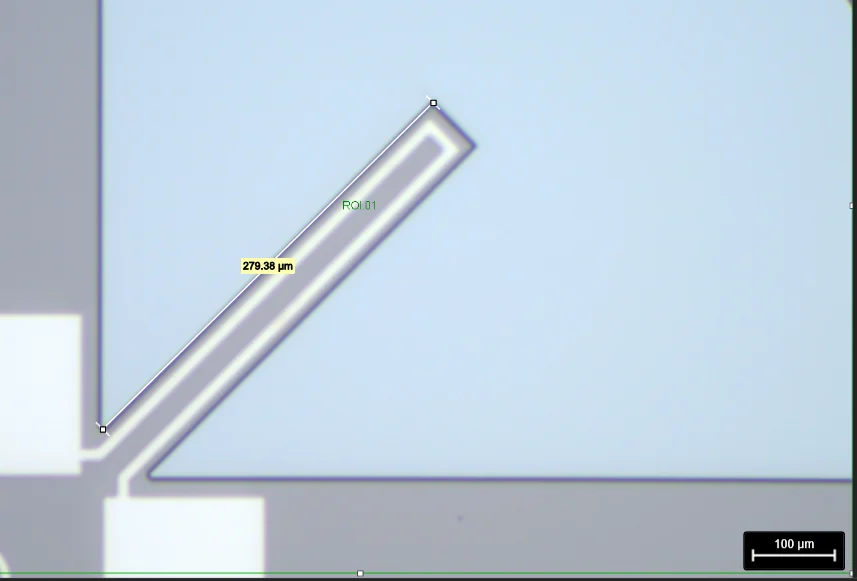
A composite-beam model gave resonances of about 6.7 kHz for a 500 µm by 80 µm cantilever and 18.9 kHz for a 300 µm by 40 µm one. To raise the latter’s frequency by a factor of 1.13, its length was reduced to about 282 µm, using the inverse-square relation between frequency and length.
-
Designing a releasable actuator geometry
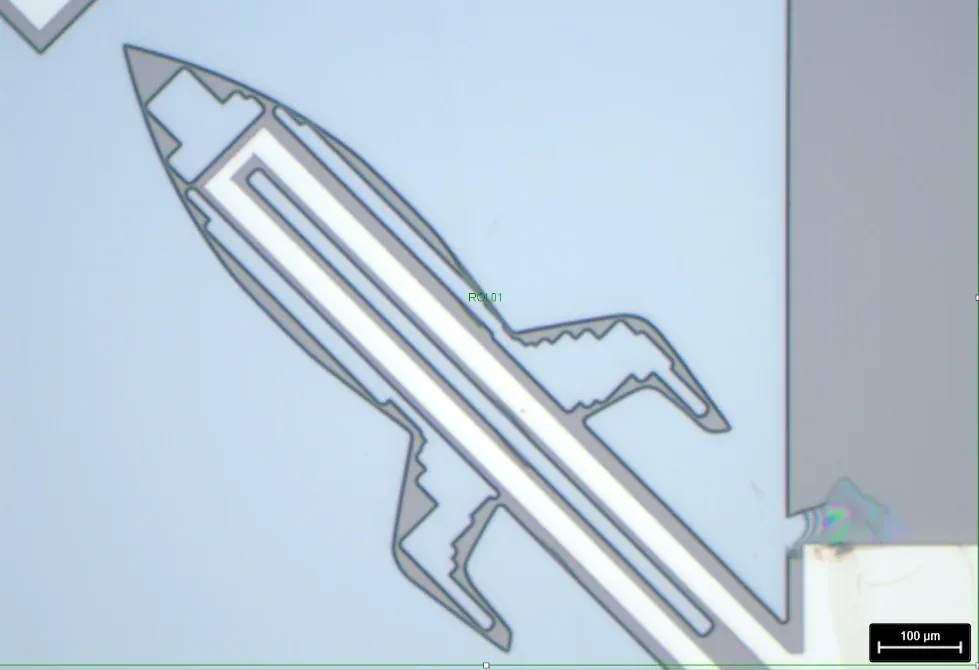
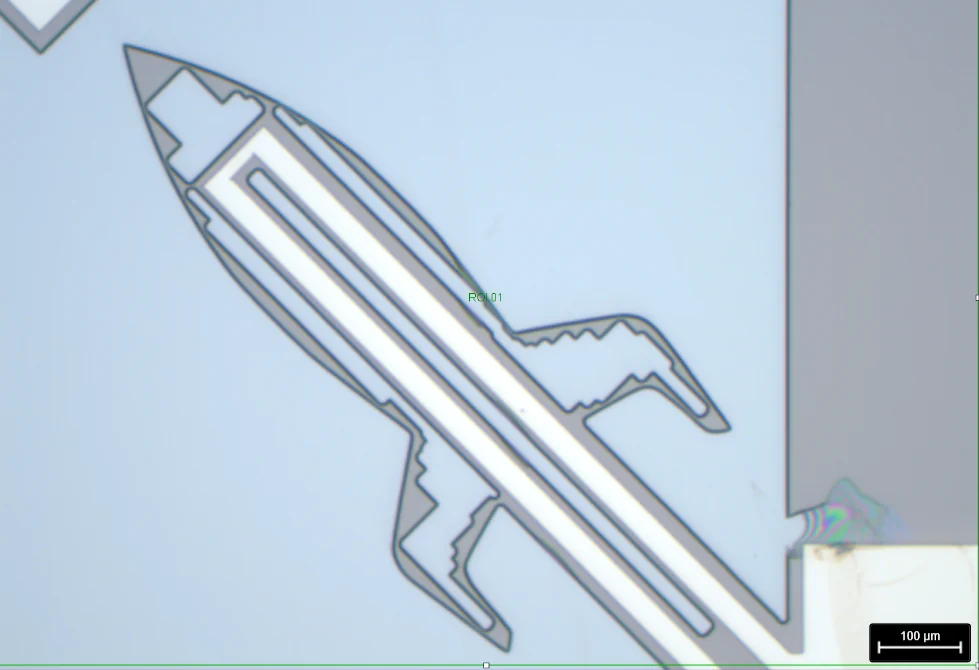
Alongside the cantilevers, our three-person team also designed a rocket-shaped actuator. The initial layout could not be released within the 130-minute etch. We adjusted the heater-track length and added holes until the KOH etch simulation predicted complete release; microscope inspection confirmed it.
-
Silicon etching and cantilever anchoring
Potassium hydroxide removes the silicon beneath the beams while etching the {111} planes much more slowly. Our simulation showed that a corner anchor allows diagonal undercutting and release. An anchor at the middle of a side leaves {111} planes along the beam, preventing the intended release.
-
Mask alignment and layer thickness
Two cleanroom sessions at CMi defined the chromium heaters and silicon dioxide beams, using lithography, metal etching and buffered hydrofluoric acid. Vernier marks indicated 400–500 nm misalignment against a 5 µm critical dimension. Profilometry measured 1.468 µm of oxide and 0.415 µm of chromium.
-
Measuring mechanical resonance
Within 5 % of the analytical prediction
Using a stroboscopic microscope, our team swept the excitation frequency to find maximum cantilever motion. Resonances were 7 kHz against a 6.7 kHz prediction and 18.6 kHz against 18.9 kHz, within the report’s 5 % tolerance. The shortened cantilever resonated 1.14 times higher than its twin, compared with the designed factor of 1.13.
-
Electrical resistance and heating limits
The tracks measured 206 Ω and 260 Ω against predictions of 12.5 Ω and 14.9 Ω. Pad and probe-contact resistance, together with chromium oxidation, limit interpretation of this difference. Above about 5 V peak to peak, narrow track sections melted, establishing a practical limit for the applied drive.
My contribution
In a three-person team, I worked on the design, etch simulation, cleanroom fabrication and characterisation of thermal MEMS actuators.